
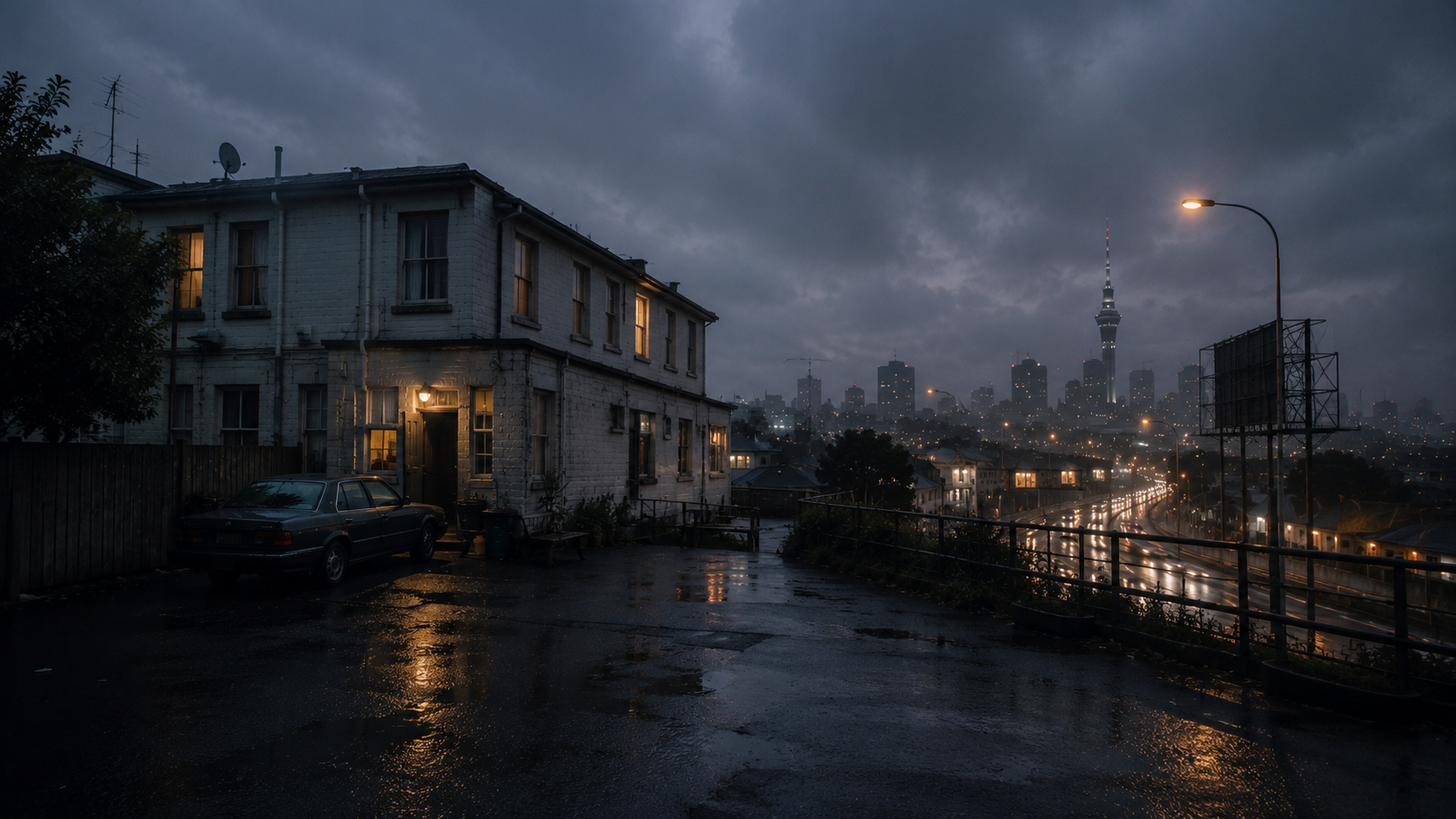
Each morning, the drilling began before I could decide whether I was awake.
Outside my window, another section of the billboard disappeared into place. Each day another panel went up, and a little more of the city vanished.
The lodge stood just off Karangahape Road, near cafés and galleries that gave the neighbourhood a sense of perpetual anticipation. Inside were tired couches, a communal kitchen, and narrow corridors with lights that flickered constantly.
The day I moved in, several residents were gathered in the common room: a Korean couple ate silently, two Indian students argued in quick, rising voices, and a blonde New Zealander lay across a couch. Near the rear exit, a shabby-looking man rolled tobacco beneath the NO SMOKING sign while a man in a black kippah stood over a pot.
My friend Guy helped carry my belongings upstairs. Once we were done, we went out for a few drinks to a nearby pub. We drank more than the effort deserved, our conversation circling a trip to the South Island, music, then the same plans again, as if repetition might conjure certainty. By the time we parted, the evening had acquired that generous vagueness that comes with too much drinking. A little tipsy, I walked back to the lodge.
The lodge was louder when I returned. Music came from the lounge, laughter from the kitchen, and an argument from somewhere above. The man in the kippah moved softly among the others, neither avoiding them nor quite belonging.
Rumor offered little. J had been here longer than most, though not as long as the unemployed man with the tobacco, who’d occupied the same room for over seven years and greeted the recession with cautious approval. The Korean couple and the Indian students were here on temporary visas, planning for their future elsewhere. People arrived with contracts or courses, each presuming the lodge would soon be behind them.
It was a weekday the next day, so I greeted everyone in the lounge and called it a night.
Weeks began with work and ended with the expectation of relief. By Friday night, I could no longer remember what the weekend was meant to save me from.
After two years in Kolkata, I’d acquired a taste for Bengali food. That Friday, craving chicken curry, I bought what I needed on my way home, along with a bottle of white wine to wash down the week. The kitchen was nearly empty; only J moved there quietly, absorbed in his own preparations.
“What are you making?” I asked.
He looked at the pizza, then at me, as though a trick might be concealed in the question, and softly answered, “Pizza”.
His voice was soft, a little formal. He placed mushrooms, pineapple, ham, and bacon with care. The kippah and the pork contradicted something I thought I knew, though the contradiction likely belonged to me.
We cooked in silence. He might have been in his late thirties, lean and a little stooped, with a light gold beard and pale skin that flushed easily. His eyes carried the look of someone long resigned to waiting for explanations that never come.
When the oven timer rang, he reappeared almost instantly. At the sight of the pizza, his face brightened, youthful for a moment.
We ate at the same table but did not share our meals. I offered him wine. He declined with a brief shake of his head.
After dinner, I walked along K. Road. The cafés were crowded, music spilled each time a pub door opened, and people waited beneath the awnings for friends or buses. I walked to the end of the road, crossed over, and returned on the other side.
Back at the lodge, bags and boxes lay in the corridor, bound with duct tape. A large figure emerged, hauling one of them.
I offered to help, but didn’t wait for his reply. I picked one of the boxes and took it inside, then helped him with the rest.
His name was Joe, newly arrived from the Bay of Plenty to study music and creative arts. He talked with such immediate openness that within minutes I knew what he played, what he hoped to play, which musicians had disappointed him, and where he believed modern jazz had gone wrong.
He asked about the nearest supermarket. I promised to drive him there the next morning.
Joe bought provisions as if preparing for winter. That evening, he invited me to dinner: mashed potato and kumara, bacon, salad, steak. While we ate, he spoke about bass players with the seriousness of a man giving evidence.
He cleared the plates and brought out his bass guitar—a dark-bodied instrument, carefully maintained. On his broad shoulder, it looked almost modest. He struck a low note and waited for the room to stop vibrating.
I fetched my guitar.
We began with a loose funk progression. Joe found the rhythm and held it steady, cheerful and precise. I played one of my songs; his bass lines made it sound more complete than I remembered writing it.
J appeared in the doorway. He listened for some time before speaking.
“That is good,” he said.
Joe handed him a beer. J accepted, sitting with the bottle between his hands. As we played, he smiled now and then—not at us, but at something the music had returned to him.
We played for a while, then Joe rolled a joint, and we slipped down to the car park, where no one cared to enforce the rules.
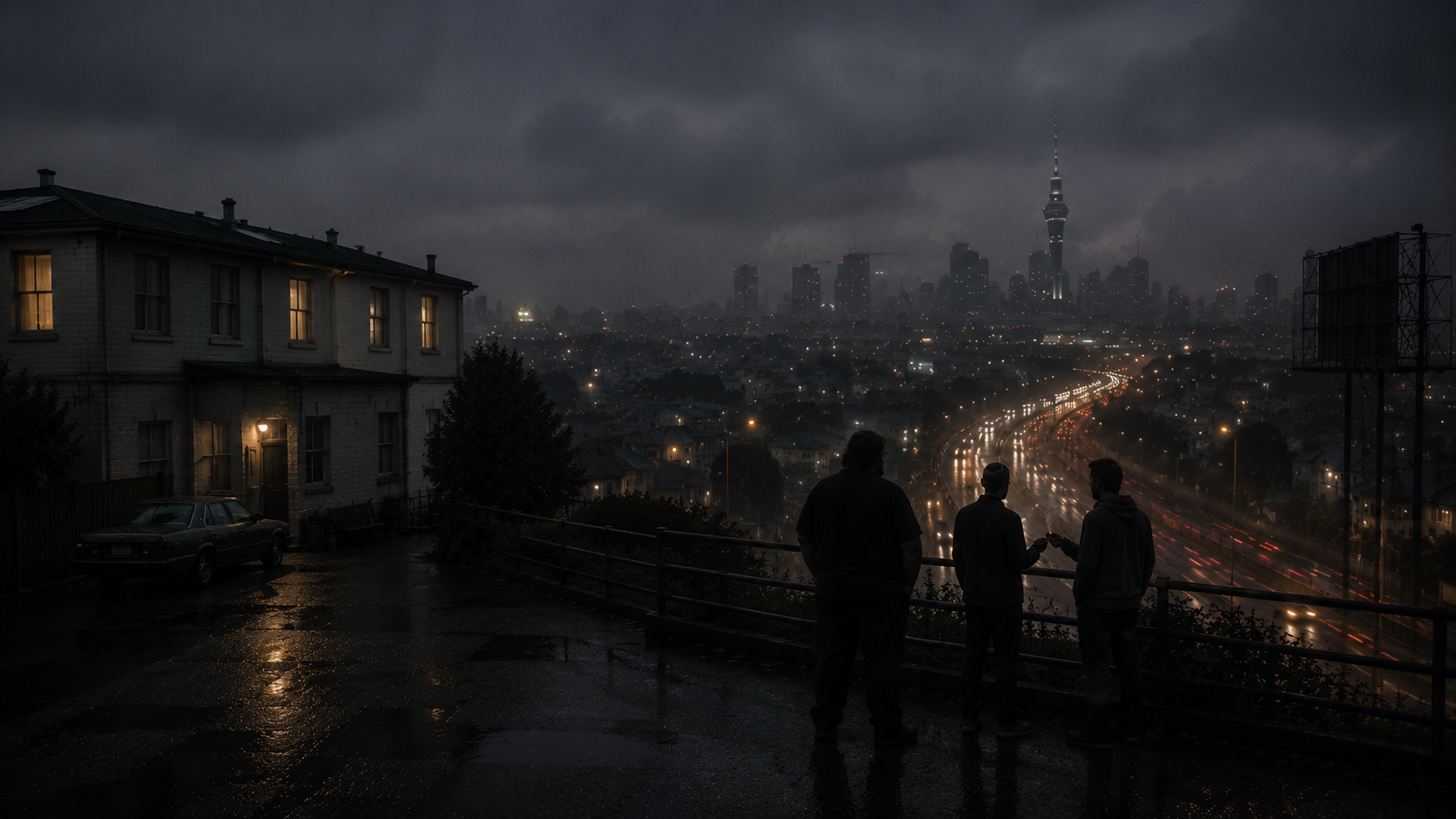
The car park overlooked the motorway. The sky had changed to grey, a red line lingering at the horizon. Cars passed in steady bursts, each visible for a moment before vanishing.
Joe lit the joint and passed it to J.
J examined it, hesitantly took a puff, then another, imitating Joe. He coughed at once, his face turning pink as tears gathered in his eyes. He passed the joint back, pressing a hand to his chest.
Joe laughed and retrieved the joint.
We stood by the low wall, the lodge rising behind us, its windows stacked in rows—identical from where we stood.
After some time, J spoke, his voice rough.
“I have lived here a long time. The rent includes everything—electricity, water…pretty much all the basic necessities. No bills coming later to tell you you’ve used too much life.”
Joe smiled, though I doubted he was listening.
J looked up at the building. “It’s a shoebox. But everything is there. A bed, a table, a door. What else do you need? People come all the time: students, travelers, people waiting for jobs. They say two weeks, then a month. You become friends, and then they leave.”
The traffic continued below.
“At first I took photographs. My wall is covered with them. Sometimes I look at a face and know I loved that person, but I cannot remember the voice.”
He gave a small, mirthless laugh.
“I do not have a computer. No phone. Even if I did, what would I say?”
Neither Joe nor I had a reply.
He turned toward us.
“They go home. Or somewhere else. To see them, I need money, a passport, permission. They ask where I was born, what country, what religion. They ask these things before they ask my name.”
“Mate,” Joe said, “you’re doing my head in.”
He began rolling another joint.
J fell silent. His breathing remained shallow, whether from the smoke or from speaking, I couldn’t tell.
I looked up at the lodge windows. Somewhere among them was my half-unpacked room. I was still waiting to hear about an apartment. I imagined I’d be gone within the week.
We watched the motorway until the red faded from the sky.
Upstairs, I put away my guitar and dropped onto the bed. The beer and smoke made the room tilt gently around me.
Just as I was falling asleep, my laptop announced a missed call from my partner, whom I called Boss—a joke that had outlived its humor.
When I logged in, several messages awaited. Boss appeared immediately, her irritation and relief overlapping, her voice rising as if volume could anchor my drifting attention.
While she spoke, I noticed a new email.
The apartment I’d applied for was available. I could move in Monday.
I accepted at once.
The next morning I woke late. For several seconds, I couldn’t understand what was wrong.
Then I realized there was no drilling.
I raised the blind. The billboard was complete.
It covered nearly the entire window. Where the motorway had been, an enormous advertisement pressed close to the glass. The city was gone, replaced by a perfected surface. Even daylight arrived processed, filtered of meaning.
It was my last day at the lodge.
Most residents gathered in the lounge. The Korean couple ate at the table, the two Indian students quarreled over a newspaper, the unemployed man slept on the couch beneath an unheeded television.
J was making tea.
He poured a second cup and handed it over.
“You are awake,” he said.
We stood near the counter. I meant to tell him I was leaving. The sentence seemed simple in my head.
I tried twice, but spoke instead about the billboard.
J looked toward the corridor, as if he could see through the walls.
“They finish everything eventually,” he said.
That afternoon, I met Guy for lunch. We drove to the beach and watched the sun set over the water. I thought of the sunset above the motorway, of J rubbing his chest beneath the windows.
When I returned, the building was quiet. Everyone had withdrawn into their rooms. I carried my bags to the car so I would not have to do it in the morning.
I lay awake for most of the night.
J’s words returned in fragments: the photographs, the forgotten voices, the men at borders demanding explanations. Yet what unsettled me most was simpler. He had described the people who stayed only a little while. I had listened without realizing he was describing me.
Before dawn, I made tea and took a cold shower. I cleaned the room, checked the cupboards, carried the last bag downstairs.
I paused outside J’s door.
The corridor was silent. Behind the door, he might have been asleep or listening, as he had been for the oven timer. I raised my hand, then let it fall.
I left without saying goodbye.
At work, I could barely remain awake. By noon I excused myself and drove to the new apartment.
It stood fifteen minutes from the city, in a quiet neighborhood with a courtyard, a garden, and private parking. My bedroom was large, the en-suite bright, the windows looked onto trees instead of traffic.
I unpacked my suitcase in the middle of the room.
That night nothing woke me.
Still, I remained awake.